The Tile Hunter
The man saving Barcelona, one tile at a time.
One of a kindBarcelona's own history, rescued from the skip.
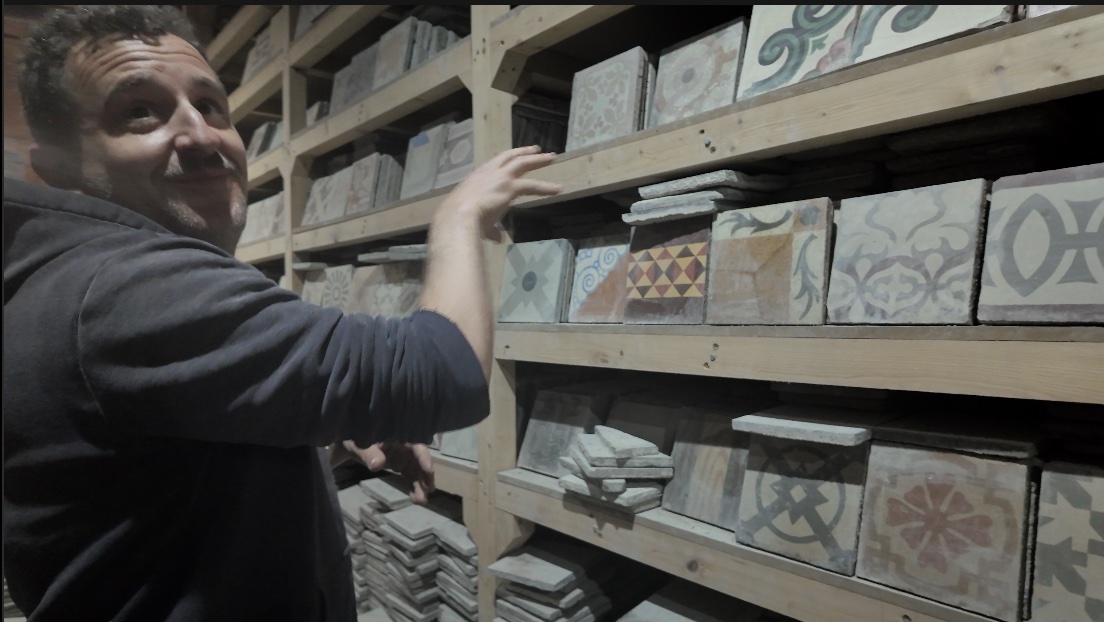
Every day, somewhere in Barcelona, a 100 year old floor goes into a skip. Joel Cànovas tries to get there first.
On a bike, with a backpack, he has rescued more than 300,000 hydraulic cement tiles from renovation sites, cleaned them, catalogued them, and found them new homes, from Barcelona to Los Angeles and Australia.
In this video we follow one rescue from the message to the warehouse, walk through what may be the largest collection of hydraulic tile patterns in the world, about 5,000 of them, and watch a tile being made the way it was made a century ago: pigment, marble dust and cement, poured into a brass mould, pressed at 15 tonnes, and left to dry for 28 days.
Hydraulic tiles, mosaico hidráulico in Spanish, rajola hidràulica in Catalan, are not fired. They are cement, marble dust and pigment pressed in a mould and cured, and they covered the floors of Barcelona from the 1880s to the 1950s. Each pattern belongs to a factory, a time and a place.
Rescue
Saving the hydraulic tiles that built Barcelona, one demolition at a time.
Craft
The patterns, makers and techniques behind a century of Catalan tile.
Made the old way
Pigment, marble dust and cement, poured into a brass mould and pressed at 15 tonnes.
Watch The Tile Hunter.
12:36 · On YouTube and Instagram.
Work with us Every video here begins with someone who built a life of their own. Built one, designed one, or dreaming of one? Tell us about the house. We reply within 48 hours.
Tell us →